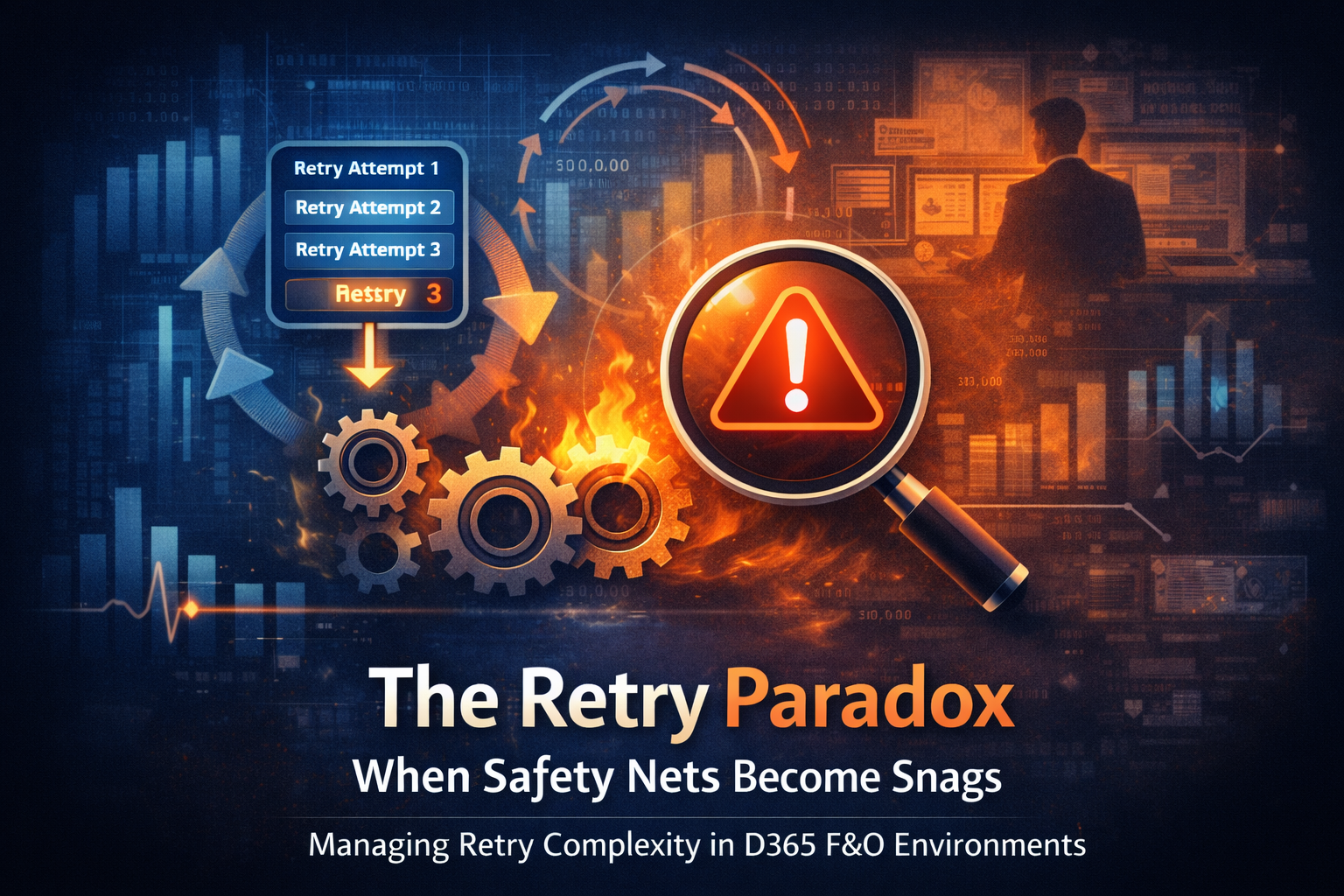
The Retry Paradox — When Safety Nets Become Snags
Retries are designed to make systems resilient.
In theory, they protect integrations and batch jobs from transient failures.
In practice, retries are one of the most common reasons production issues become harder to detect, slower to resolve, and more disruptive over time.
This week’s insight looks at the retry paradox — situations where retries quietly turn small, recoverable issues into systemic risk in Dynamics 365 Finance & Operations environments.
Why retries exist in the first place
Retries are meant to handle:
- Temporary network issues
- Short-lived service outages
- Momentary resource contention
When used correctly, they reduce noise and prevent unnecessary failures.
The problem starts when retries are treated as a default safety net instead of a deliberate design choice.
When retries stop helping
Retries become dangerous when they:
- Mask real failures
- Extend execution without visibility
- Create backlog pressure
- Hide performance degradation
- Delay root-cause discovery
Instead of failing fast, the system fails slowly — often without triggering alerts.
How retries hide real problems
In many D365 F&O environments, retries are invisible by design.
A batch job retries, eventually succeeds, and reports success.
An integration retries multiple times before completing.
A service call stalls, retries, and finishes late.
From the outside:
- The job “worked”
- The data “arrived”
- The system “recovered”
Internally, the system just absorbed stress — quietly.
The compounding effect in batch processing
Retries rarely exist in isolation.
When multiple batch jobs retry at the same time:
- Execution windows expand
- Batch overlap increases
- Resource contention grows
- Downstream jobs start late
What began as a single transient issue turns into a cascading slowdown across the batch framework.
Retries and performance degradation
Retries don’t just delay completion — they distort performance signals.
Common patterns include:
- Execution time creeping upward over weeks
- Batch jobs completing just before the next window
- Performance issues appearing “random”
- Telemetry showing success without context
Because retries smooth over failures, performance degradation often goes unnoticed until the system is under sustained load.
Retry storms: when protection becomes pressure
A retry storm occurs when:
- Multiple jobs retry simultaneously
- Failures are correlated (same root cause)
- Backoff logic is poorly tuned
- No throttling or circuit breaking exists
In these scenarios, retries actively increase system pressure, making recovery harder rather than easier.
Why success status is misleading
One of the most dangerous assumptions is:
“If the job succeeded, the system is healthy.”
Retries break that assumption.
A successful job that required:
- multiple retries
- extended execution
- delayed downstream processing
…is already signaling instability.
Success without context is not success.
Making retries observable
Retries are not inherently bad — unobservable retries are.
Healthy environments:
- Track retry counts, not just failures
- Monitor execution duration trends
- Alert when retry behavior changes
- Correlate retries with performance metrics
The goal is not to eliminate retries, but to understand when they are compensating for deeper issues.
Designing retries with intent
Effective retry strategies include:
- Clear retry limits
- Meaningful backoff intervals
- Telemetry on retry frequency
- Alerts when retries exceed baseline behavior
- Fast failure for non-transient errors
Retries should protect stability — not hide fragility.
Final thoughts
Retries are powerful, but they are not neutral.
Used carefully, they improve resilience.
Used blindly, they delay detection and amplify risk.
Key takeaway:
If retries are never discussed, reviewed, or measured, they are probably hiding something important.