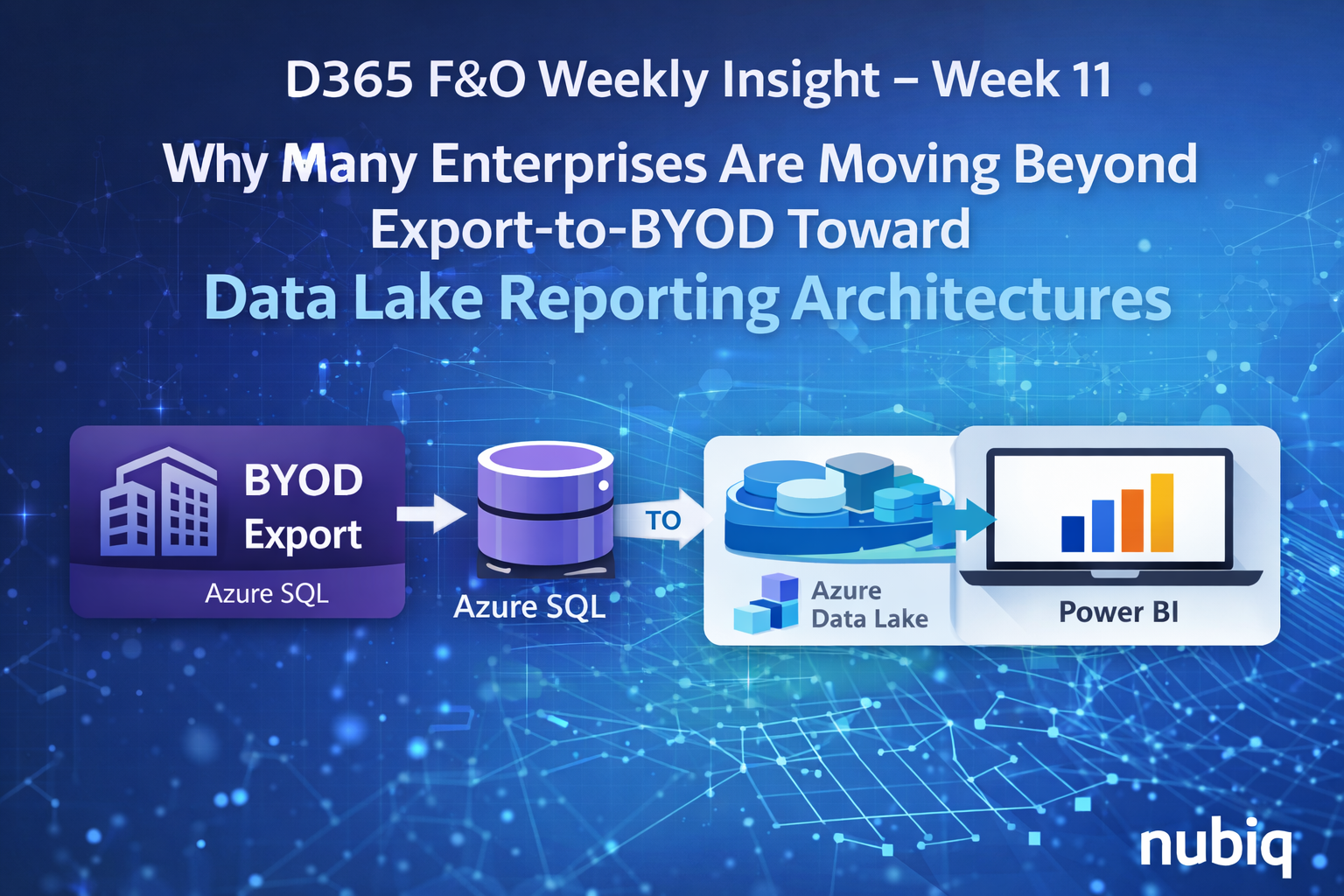
Why Many Enterprises Are Moving Beyond Export-to-BYOD Toward Data Lake Reporting Architectures
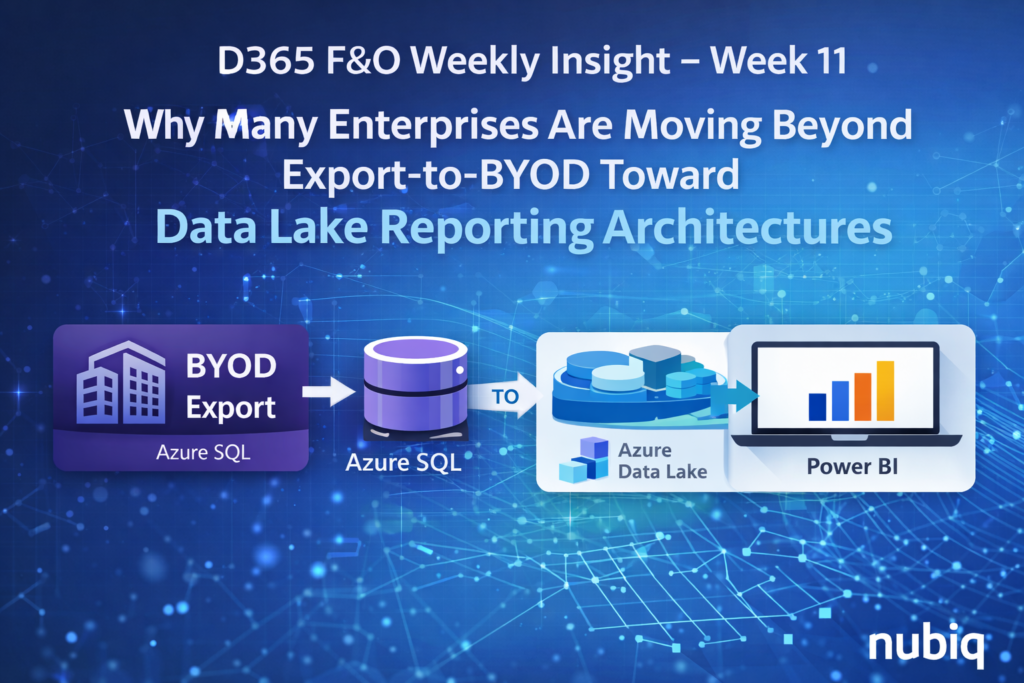
In many enterprise Dynamics 365 Finance & Operations implementations, operational reporting depends on data exported from the ERP system into external databases such as Azure SQL using the Export-to-BYOD framework.
For years, this approach provided a practical way to enable reporting tools such as Power BI without directly querying the transactional database.
However, as enterprise data volumes have grown and reporting requirements have become more advanced, many organizations have started to encounter limitations with this architecture.
Increasingly, enterprise teams — including Microsoft architects and FastTrack advisors — are recommending a shift toward Data Lake–based reporting architectures that provide greater scalability, flexibility, and long-term data retention.
Understanding this architectural evolution is important for teams designing modern reporting solutions around Dynamics 365 Finance & Operations.
The Traditional BYOD Reporting Architecture
In a typical Export-to-BYOD architecture, data flows through the following pipeline:
D365 Finance & Operations → Data Management Framework Export → Azure SQL Database → Reporting Layer → Power BI
This model works well for smaller datasets and straightforward reporting scenarios.
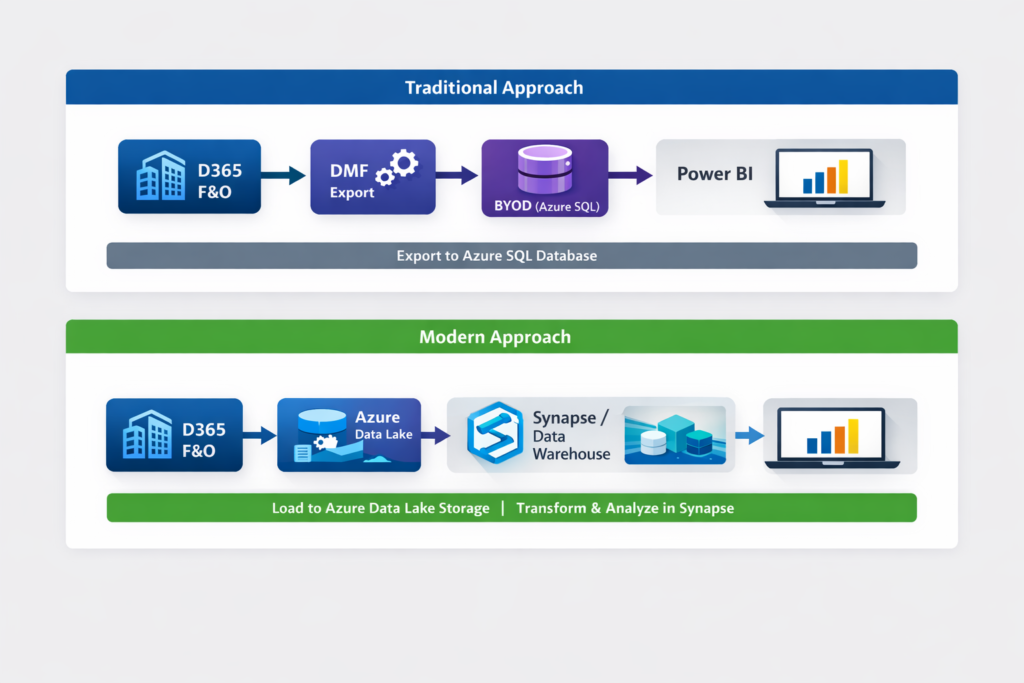
In this architecture:
• Data entities are exported from D365
• Export jobs run through batch processing
• Data is pushed into an Azure SQL database
• Reporting tools query the exported tables
Because the reporting queries are executed outside the transactional ERP database, the approach avoids performance impact on operational workloads.
For many implementations, this architecture served as the foundation for reporting systems during early D365 deployments.
Challenges Organizations Encounter with BYOD
As enterprise environments scale, several practical challenges often emerge when relying heavily on BYOD exports.
One common limitation is data volume scalability.
Large enterprise systems may process millions of transactions daily. Exporting large datasets through DMF pipelines can create significant operational overhead and may require careful scheduling and monitoring.
Another challenge is incremental synchronization complexity.
Export pipelines depend on mechanisms such as change tracking and incremental push, which must remain synchronized between the ERP system and the external database. When this synchronization breaks, reporting systems may silently stop receiving updates.
Organizations may also encounter limitations when trying to maintain long-term historical data.
Because BYOD typically exports a limited subset of entities required for reporting, retaining several years of raw operational data can become difficult.
Finally, complex reporting architectures built on BYOD often require additional transformation layers, increasing operational dependency on scheduled jobs and data processing pipelines.
The Rise of Data Lake–Based Reporting Architectures
To address these limitations, many enterprise teams are now adopting Azure Data Lake–based architectures for reporting and analytics.
Instead of exporting selected data entities into relational databases, this model continuously streams large volumes of ERP data into a centralized data lake designed for large-scale analytics.
In this architecture, the pipeline typically looks like this:
D365 Finance & Operations → Data Export → Azure Data Lake Storage → Data Transformation Layer → Analytics Platform → Power BI
Azure Data Lake Storage is designed to handle massive datasets and enables organizations to retain long-term historical operational data.
This approach separates transactional systems from analytical workloads more effectively and provides a flexible foundation for advanced analytics scenarios.
Advantages of Data Lake Reporting Architectures
Data Lake–based architectures provide several advantages compared to traditional BYOD pipelines.
First, they offer greater scalability.
Data lakes are designed to store extremely large datasets efficiently, making them suitable for organizations processing high transaction volumes.
Second, they enable long-term data retention.
Organizations can maintain raw historical data over many years, enabling advanced analytics and regulatory reporting.
Third, they provide greater flexibility for analytics platforms.
Data stored in a lake can be consumed by multiple systems, including:
• Power BI
• Azure Synapse Analytics
• machine learning platforms
• enterprise data warehouses
This enables organizations to build modern data platforms around ERP systems rather than relying solely on relational reporting databases.
Modern Enterprise Reporting Architecture
In many modern implementations, reporting architectures now include multiple analytics components layered on top of the data lake.
A typical architecture may include:
D365 Finance & Operations
↓
Azure Data Lake Storage
↓
Azure Synapse / Data Warehouse Layer
↓
Transformation Pipelines
↓
Power BI Semantic Models and Reports
This architecture allows organizations to combine ERP data with data from other enterprise systems while maintaining scalable analytics infrastructure.
Final Thoughts
Export-to-BYOD has served as a practical reporting solution for many Dynamics 365 Finance & Operations environments.
However, as data volumes grow and enterprise analytics requirements become more sophisticated, organizations are increasingly evaluating data lake architectures as a more scalable foundation for reporting.
Understanding this architectural shift helps teams design solutions that are better aligned with modern data platforms and long-term enterprise reporting strategies.
Key Takeaways
• Export-to-BYOD has historically been a common reporting architecture for D365 Finance & Operations.
• Large enterprise environments may encounter scalability and synchronization challenges with this model.
• Azure Data Lake architectures provide greater scalability and long-term data retention.
• Modern reporting solutions often combine Data Lake storage with analytics platforms such as Synapse and Power BI.
• Evaluating reporting architecture early can help organizations build more resilient enterprise data platforms.