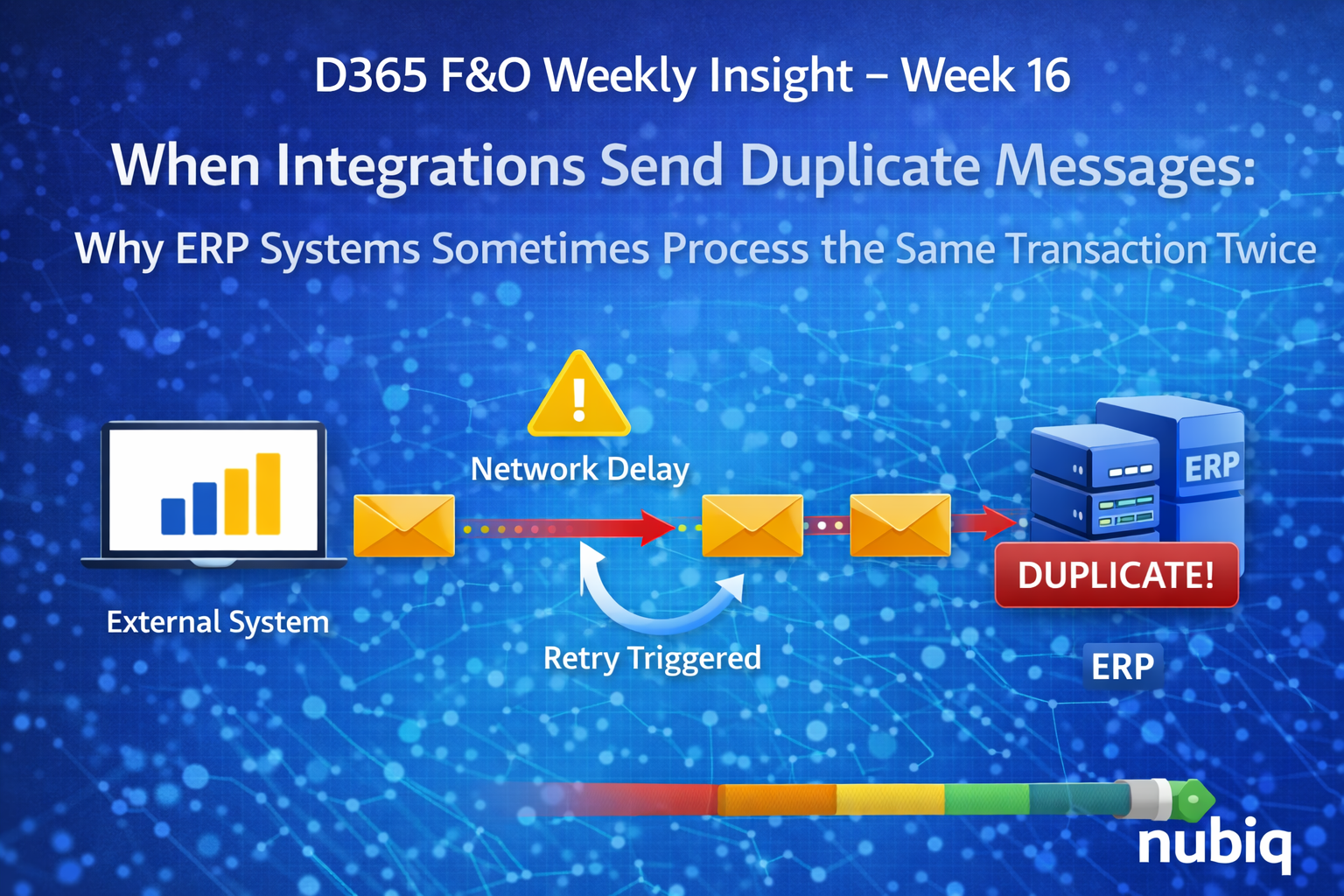
When Integrations Send Duplicate Messages: Why ERP Systems Sometimes Process the Same Transaction Twice
Modern Dynamics 365 Finance & Operations environments rely heavily on integrations with external systems.
These integrations may connect the ERP system with:
• point-of-sale platforms
• warehouse management systems
• vendor portals
• regulatory reporting systems
• enterprise analytics platforms
While integrations automate business processes and enable real-time data exchange, they also introduce new operational challenges.
One of the most common issues in distributed systems is duplicate message processing, where the same transaction is processed more than once by the ERP system.
In enterprise environments, this can result in unexpected outcomes such as:
• duplicate purchase receipts
• repeated inventory updates
• duplicate financial transactions
• incorrect reporting results
Understanding why duplicate messages occur helps organizations design more reliable integration architectures.
Why Duplicate Messages Occur in Distributed Systems
In distributed systems, communication between systems typically occurs over networks.
Because network communication is not always perfectly reliable, integration systems often implement retry mechanisms.
If the sending system does not receive a confirmation response within a certain time window, it may resend the message.
While this retry behavior helps ensure that messages are eventually delivered, it can also result in the same message being received multiple times by the target system.
If the receiving system processes each message independently without verification, duplicate transactions may occur.
Message Retry Scenarios
Several common scenarios can trigger message retries:
• temporary network interruptions
• delayed API responses
• processing timeouts
• integration middleware retries
For example, if an external system sends a transaction and does not receive a response due to a network delay, it may resend the same request.
From the ERP system’s perspective, both messages may appear valid.
Without proper safeguards, both messages may be processed.
The Role of Idempotency in Integration Design
To prevent duplicate processing, many enterprise integration architectures implement idempotent operations.
Idempotency means that repeating the same operation multiple times produces the same result as executing it once.
In ERP integrations, this is often achieved by introducing unique identifiers such as:
• transaction reference numbers
• message identifiers
• external system document IDs
When a message is received, the system checks whether the transaction has already been processed.
If the identifier already exists, the system ignores the duplicate request.
Sequence and Timing Challenges
Another challenge in integration environments is message sequencing.
In real-world conditions, messages may not arrive in the same order they were sent.
For example:
• a delivery confirmation may arrive before the purchase order update
• an invoice update may arrive before vendor master data synchronization
When integrations assume strict ordering of messages, unexpected sequencing can create processing errors.
Robust integration designs must account for these timing variations.
Monitoring and Detecting Duplicate Transactions
Enterprise environments often implement monitoring mechanisms to detect unusual transaction patterns.
These may include:
• integration message logs
• staging tables
• reconciliation reports
• automated validation checks
By monitoring transaction flows, teams can quickly detect duplicate processing scenarios and investigate their root cause.
Final Thoughts
Duplicate message processing is a common challenge in distributed enterprise systems.
Because integrations rely on network communication and retry mechanisms, duplicate messages are sometimes unavoidable.
However, well-designed integration architectures use techniques such as idempotency, message identifiers, and validation logic to ensure that transactions are processed correctly.
Organizations that incorporate these design principles into their integration architecture are better positioned to maintain reliable and consistent ERP operations.
Key Takeaways
• Duplicate message processing is a common issue in distributed systems.
• Retry mechanisms can cause the same transaction to be sent multiple times.
• Idempotency helps ensure that repeated messages do not create duplicate transactions.
• Message sequencing and timing variations must be considered in integration design.
• Monitoring integration pipelines helps detect duplicate transaction scenarios early.