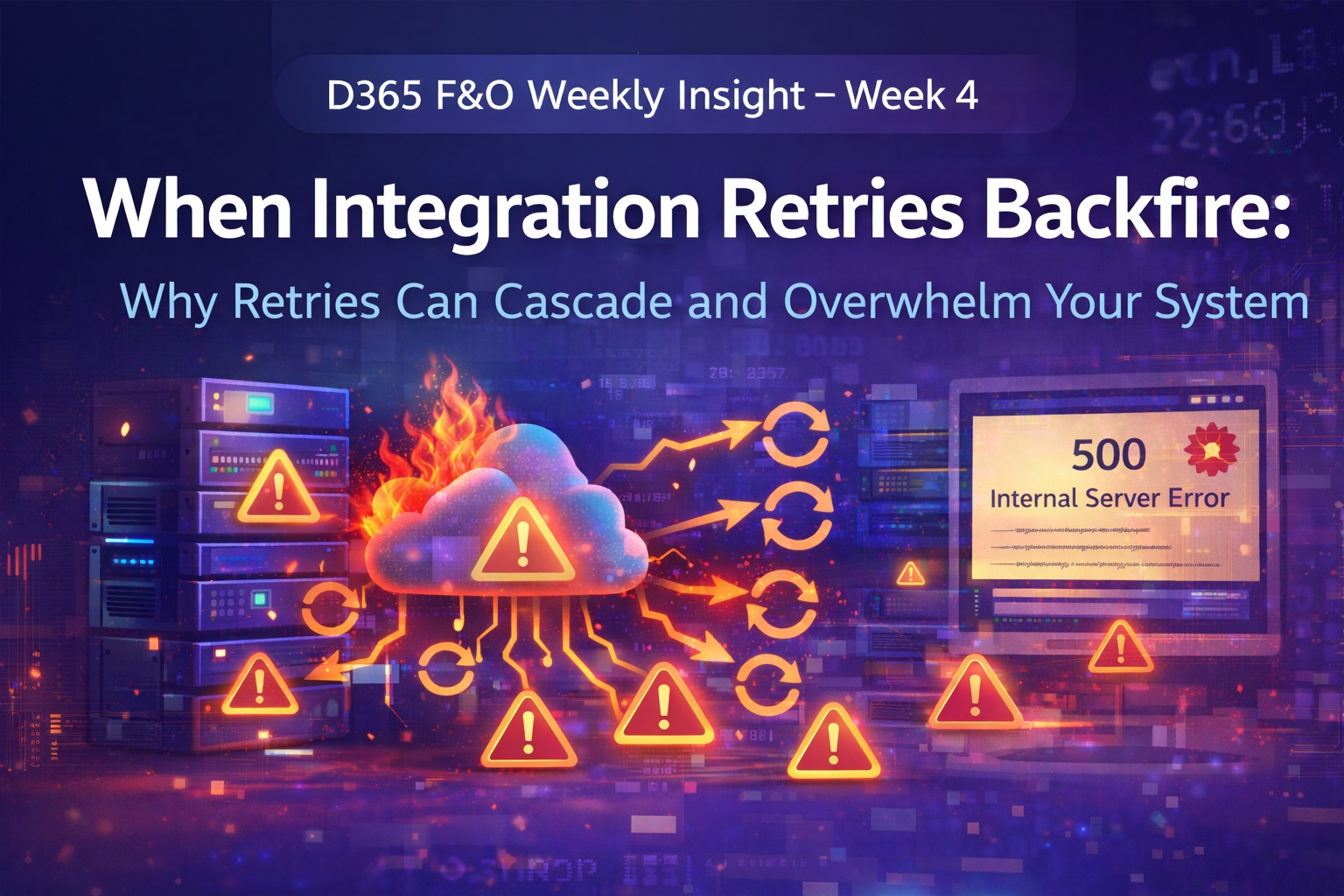
When Integration Retries Turn into a Storm
How retry logic quietly creates cascading failures
Retry logic is meant to protect integrations.
But in production, unbounded or poorly designed retries can quietly become the very thing that brings the system down.
We recently observed a D365 F&O environment where:
- Integrations were “succeeding” intermittently
- No errors were raised in monitoring dashboards
- Yet performance degraded across batch, APIs, and reporting
The root cause wasn’t a single failure — it was a retry storm.
What was happening?
When downstream systems slowed or briefly failed:
- API calls retried automatically
- File-based integrations reprocessed the same payloads
- Batch jobs re-queued themselves without backoff
Each retry multiplied load:
- SQL locks increased
- Batch threads stayed occupied
- Integration queues grew silently
Nothing “failed” outright — but everything slowed.
Why this is dangerous
Retry storms don’t look like outages:
- No red alerts
- No clear exception stack traces
- Just gradual degradation
By the time users complain:
- The original failure is long gone
- The system is drowning in self-generated traffic
Root cause (not the symptom)
The real issue wasn’t retries themselves — it was missing retry design:
- No exponential backoff
- No retry caps
- No idempotency checks
- No coordination between integration layers
Retries were acting independently, amplifying each other.
How we stabilized the system
The fix wasn’t “turn retries off.”
It was architectural:
- Introduced bounded retries with backoff
- Added idempotency keys to integration payloads
- Separated transient failures from permanent ones
- Monitored retry volume, not just success/failure
After changes:
- Load normalized
- Batch recovered
- Integrations became predictable again
Final thought
Retries are not resilience by default.
Resilience is deliberate design.
If your D365 F&O integrations retry endlessly, they may already be failing — just quietly.